

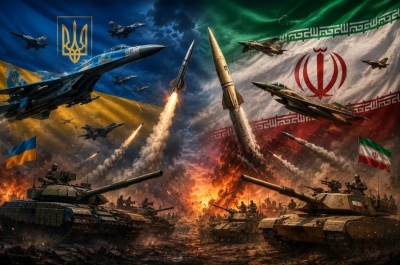
Undoubtedly, Iran's missile power is much greater, more diverse, and more strategic than Ukraine's. Iran is one of the most powerful missile forces in the world and the region, whereas Ukraine is a newcomer in this domain and depends on foreign aid. According to the latest news, there are numerous reports of military tensions between Iran and Ukraine, partly due to the striking of an Iranian ship in the Caspian Sea. While Ukraine attacked an Iranian ship, Iran's Foreign Minister threatened that Ukraine would answer for its aggression, although in the end Iran and Ukraine are trying to de-escalate the tension.
In a hypothetical conflict scenario
Although a conflict between Iran and Ukraine would likely be limited, with neither side engaging in ground, air, or armored battles, and their clash would probably be restricted to launching missiles and drones, comparing the overall capabilities of Iran and Ukraine remains an intriguing exercise.
Ukraine has a larger army
Regarding ground forces, the number of Ukrainian soldiers is larger than Iran's. Ukraine has approximately 1,250,000 active troops. Iran has around 600,000 combat-ready soldiers. Naturally, the number of Iranian Basij forces is extremely large and can be considered greater than that of the Ukrainian forces. In terms of armored forces, Iran holds a better position. Ukraine has roughly 1,462 main battle tanks. Iran possesses 2,198 battle tanks. Regarding armored fighting vehicles, Iran has 2,875 and Ukraine has 5,739 vehicles.
Iran leads in artillery
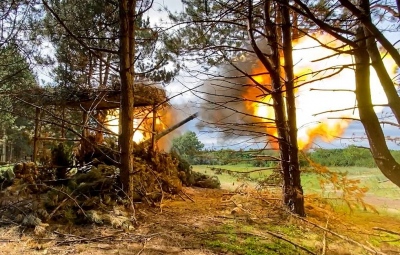
In the artillery sector, Ukraine has 3,636 pieces, whereas Iran fields 4,582 guns. Of these, Iran has 742 self-propelled guns and Ukraine has 899 self-propelled guns. Additionally, Ukraine has 693 rocket launchers compared to Iran's 1,752 multiple rocket launchers.
Superiority in air power
In terms of air power, Iran commands greater overall capacity. According to Armed Forces reports, the number of Iranian aircraft stands at 1,052, while Ukrainian aircraft total 297. Furthermore, both sides are highly active in the unmanned aerial vehicle sector.
Iran as a global drone power
Iran is recognized as a global power in drone technology. Iranian kamikaze, attack, and reconnaissance drones—specifically the Shahed models of the IRGC and the army's Arash drones—are widely renowned. On the other hand, Ukraine has collaborated with Turkey in the drone sector and has managed to make notable progress in this field.
Iran also holds naval superiority
In the realm of naval power, Iran's capability is significantly greater than Ukraine's. Iran operates a total of 279 naval vessels, whereas Ukraine has 53 ships. Iran has 7 frigates while Ukraine has only 1. Additionally, Iran possesses several dozen submarines, whereas Ukraine has none.
Iran's missile power versus Ukraine's missile power
Iran's missile power is undoubtedly much larger, more varied, and more strategic than that of Ukraine. Iran stands as one of the most powerful missile-capable nations in the world and the region, while Ukraine is a developing actor in this field that relies heavily on foreign assistance.
1) Size and scope of the arsenal
Iran maintains several thousand ballistic and cruise missiles. Pre-war estimates indicated that Iran held around 2,500 to 3,000 ballistic missile systems, and despite using them in recent conflicts, it still retains over 2,000 strategic ballistic missiles. The number of domestically produced ballistic and cruise missiles in Ukraine remains very limited, with most of its strike capability relying on a few dozen Western long-range missiles (such as ATACMS and Storm Shadow), whose delivery is also strictly constrained.
2) Diversity and operational range
Iran possesses a complete arsenal of short-range (300 km), medium-range (1,000 to 2,000 km), and even intermediate-range missiles (around 4,000 km). Missiles like the Khorramshahr, Sejil, Ghadr, and Emad cover the entire territory of Ukraine and extend far beyond. However, Ukraine's domestic missiles are primarily short-range. The recently unveiled FP-7 with a range of 200 km and the FP-9 with a range of 850 km have not yet reached operational readiness. The Neptune cruise missile also has a range of approximately 400 km. The latest Trident missile has been announced with a range exceeding 3,000 km, but it has not yet been put into operational service.
3) Technology and propulsion systems
Iran has achieved advanced solid-fuel technology (enabling faster launches and higher mobility), hypersonic capabilities (Fattah-1), and maneuverable re-entry vehicles (Emad), which facilitate bypassing air defense networks. Ukrainian missiles rely mostly on legacy technologies from the Soviet era, and its new missiles are primarily liquid-propellant cruise missiles that are less swift and complex than Iranian ballistic models.
4) Operational experience and combat effectiveness
In recent years, especially in retaliation against Israel (Operation True Promise), Iran has demonstrated its ability to launch several hundred missiles simultaneously and bypass sophisticated defensive layers. This comes at a time when Ukraine's operational experience in employing ballistic missile strikes is largely limited to short-range Iskander missiles (Russian) and Western-supplied systems. Ukraine's domestic missiles have not yet been deployed widely or effectively on the battlefield.
www.bankingnews.gr





Σχόλια αναγνωστών